Abstract
Triangle meshes provide explicit and accurate surface geometry, yet their
irregular topology connectivity makes 3D mesh tokenization a geometric
sampling problem: how to sample and organize geometric evidence into
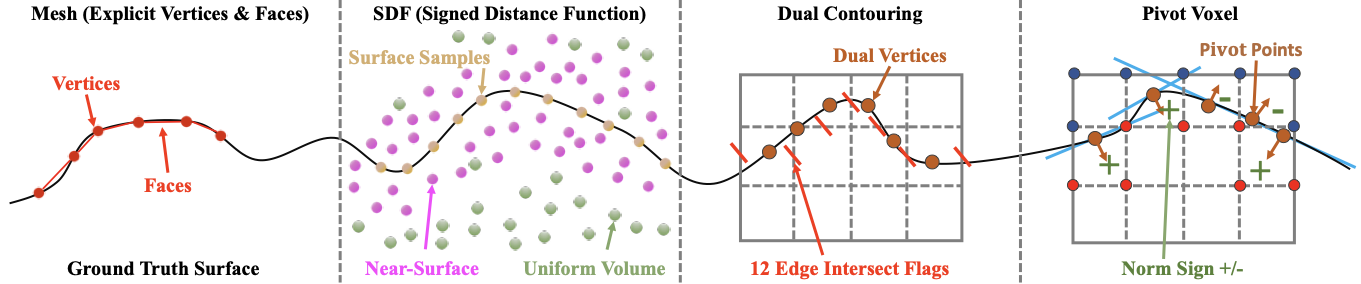
compact, structured and learnable tokens. Beyond field-centric volumetric
sampling and edge-intersection surface sampling, we retarget mesh
tokenization as local surface evidence sampling: identifying the
minimal geometric evidence inside each active voxel that is sufficient for
deterministic surface recovery.
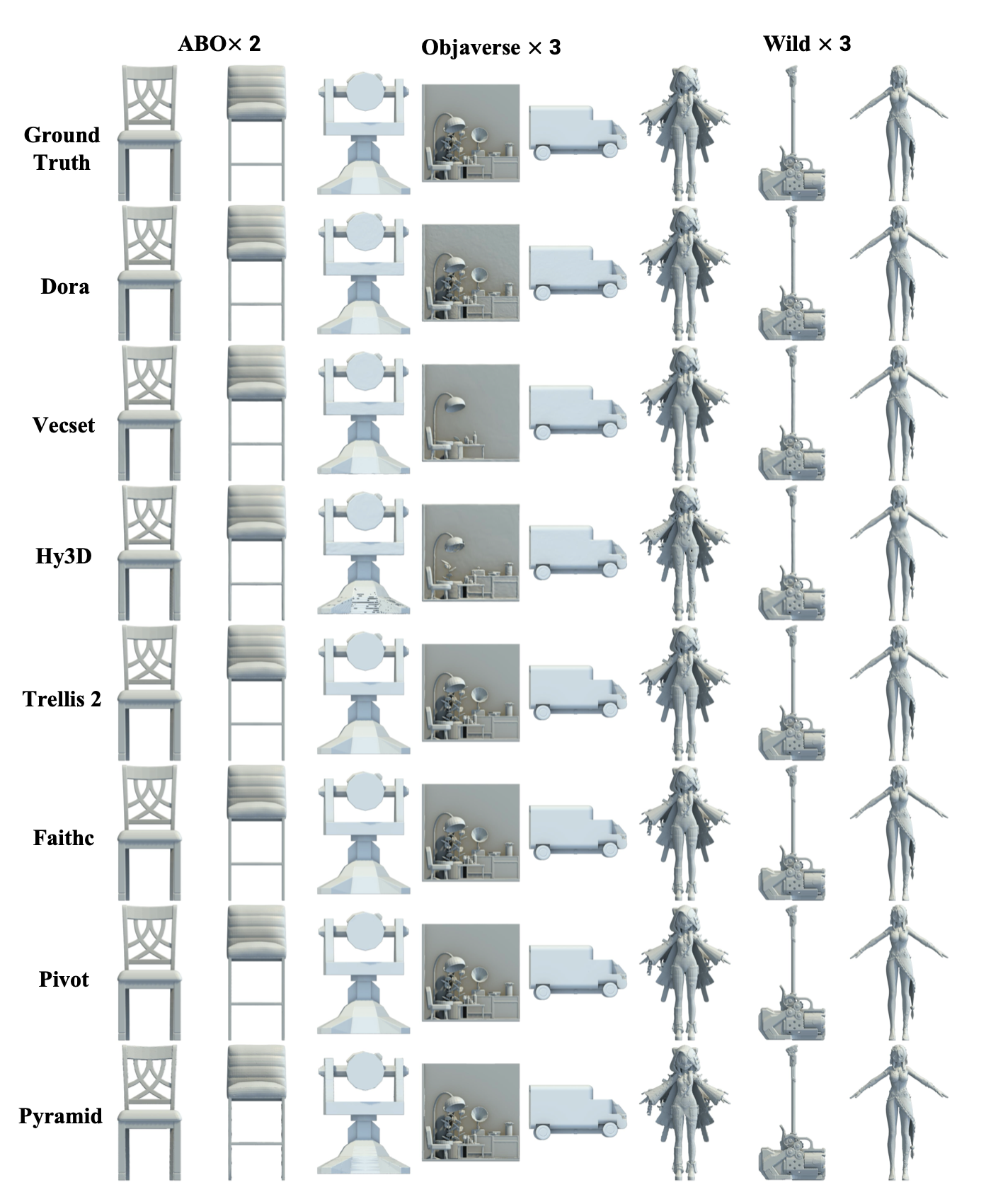
To this end, we introduce P2Voxel, a pyramid pivot
voxelization framework for compact and reconstruction-aware mesh
tokenization. P2Voxel is built on three key innovations. Under the
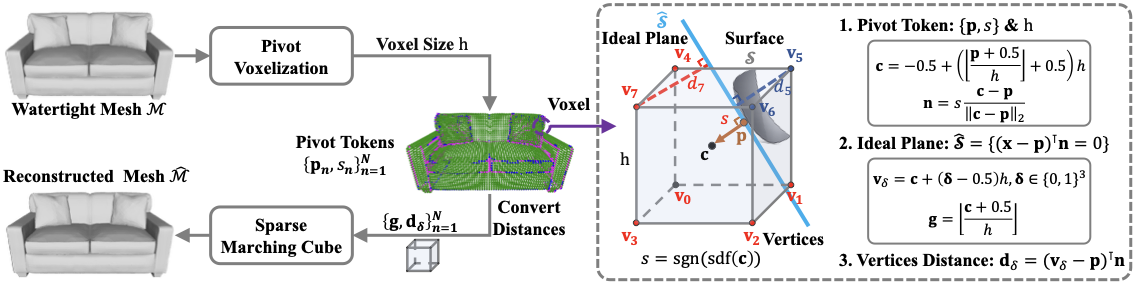
Local Planarity assumption, Pivot Voxelization represents each
active voxel with a surface pivot and an orientation sign, providing
minimal local evidence that can induce the corner values required for
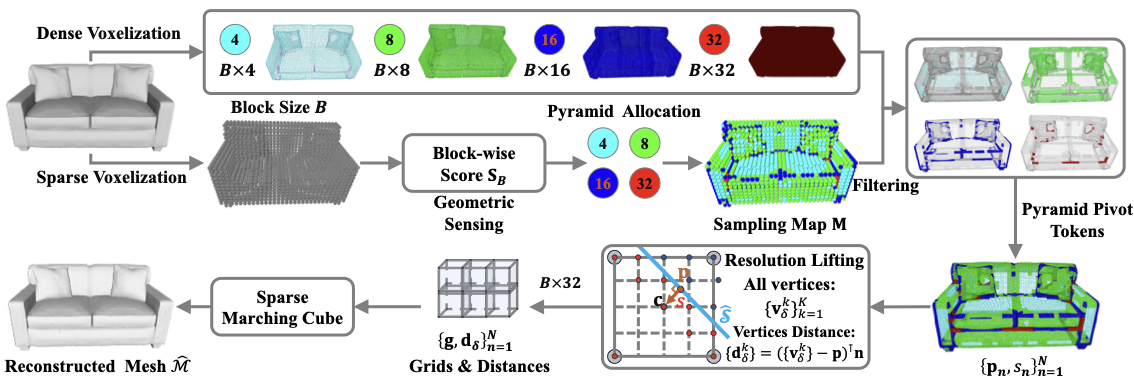
deterministic reconstruction. Under the Spatial Complexity
assumption, Pyramid Pivot Voxelization exploits the spatial non-uniformity
of real surfaces by allocating finer pivot tokens to geometrically complex
regions while keeping smooth regions coarse and compact. Under the
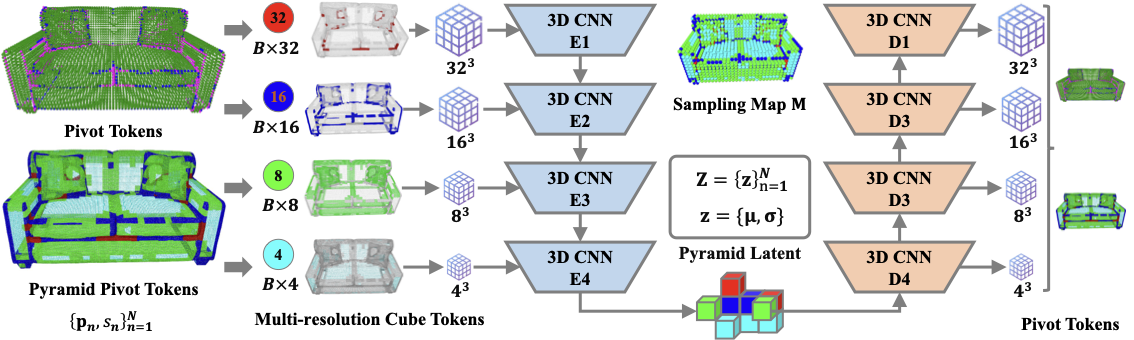
Block Reconstructability assumption, a Pyramid VAE learns compact
multi-resolution latent codes over locally reconstructable pivot blocks,
avoiding the need to model the entire high-resolution voxelized shape as a
dense global field. Together, these designs convert meshes into compact,
structured, and learnable pyramid pivot tokens, enabling efficient mesh
reconstruction for downstream 3D tasks.