Step-wise Selection
Promotes uncertain but reasoning-critical digits and symbols during progressive unmasking.
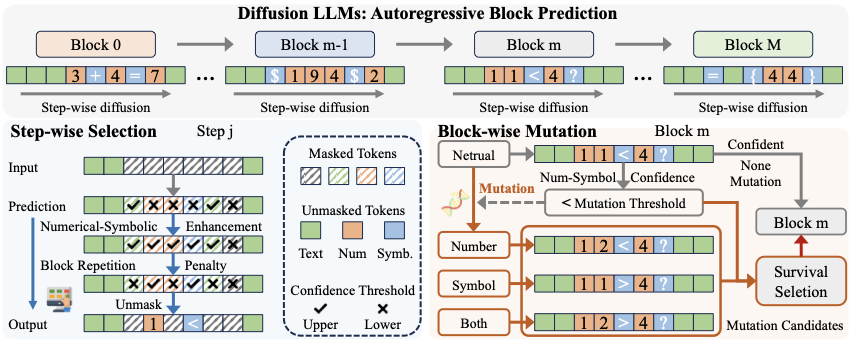
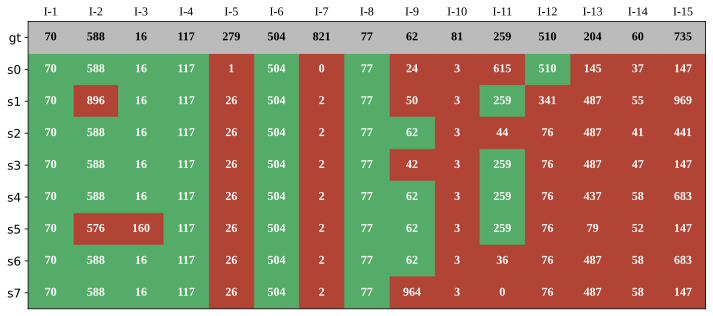
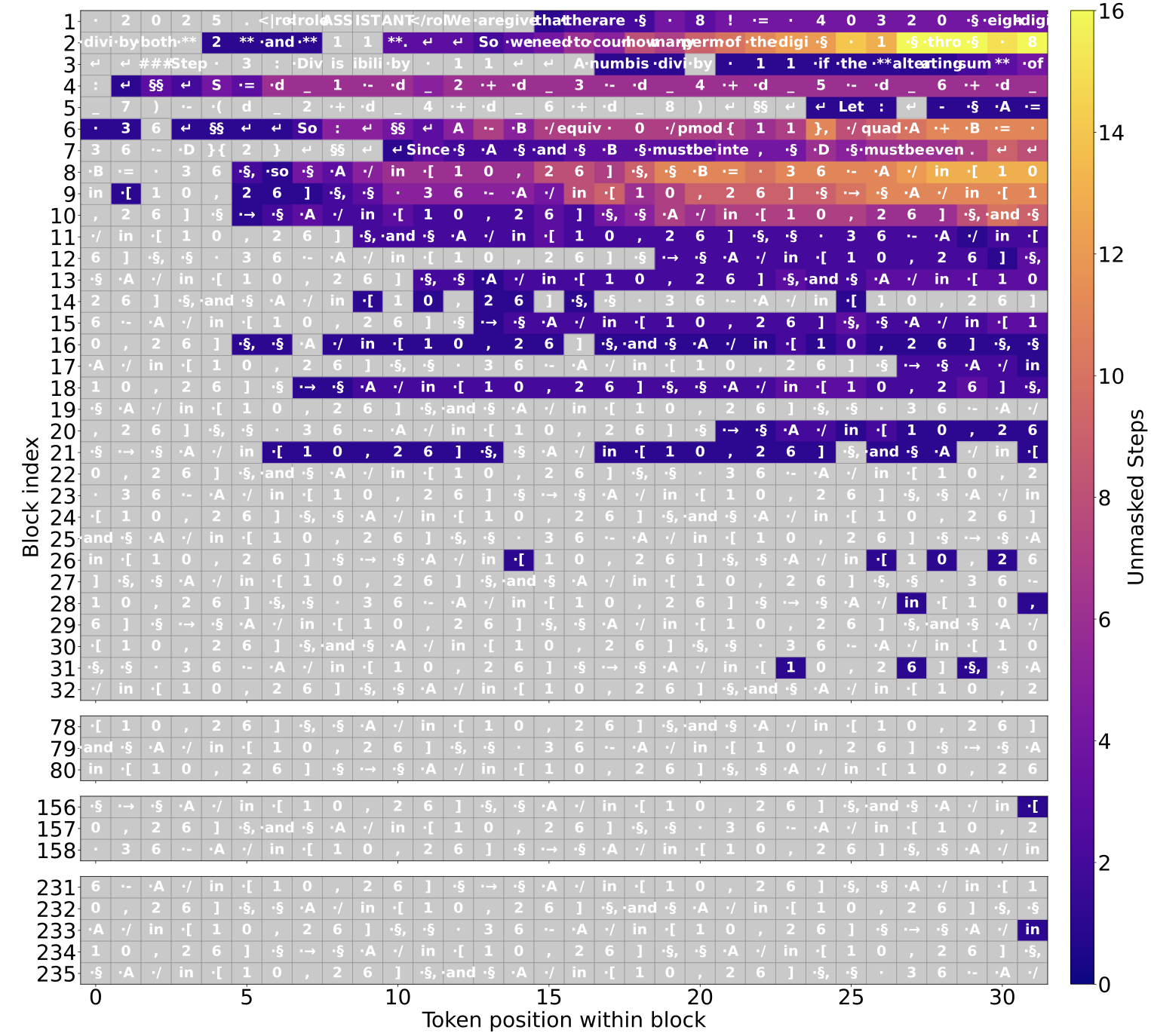
Diffusion large language models offer efficient generation through block-wise progressive unmasking, but local token confidence can become misaligned with global mathematical correctness. We identify a diffusion confidence trap with two regimes: sampling-sensitive failures, where correct paths exist but are unstable, and sampling-consistent failures, where repeated sampling converges to confident but incorrect continuations.
Evolutionary Decoding is a training-free test-time scaling framework that reshapes the decoding trajectory. Step-wise selection preserves useful numerical-symbolic signals and suppresses repetitive patterns, while block-wise mutation introduces structured alternatives to escape incorrect high-confidence basins.
Promotes uncertain but reasoning-critical digits and symbols during progressive unmasking.
Adds numerical, symbolic, mixed, and neutral branches before a block collapses into a fixed wrong direction.
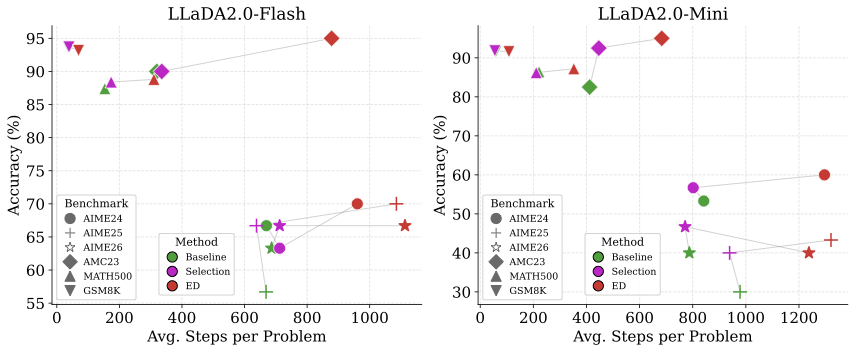
Uses frozen LLaDA 2.0 models and transfers one configuration across benchmarks and model sizes.
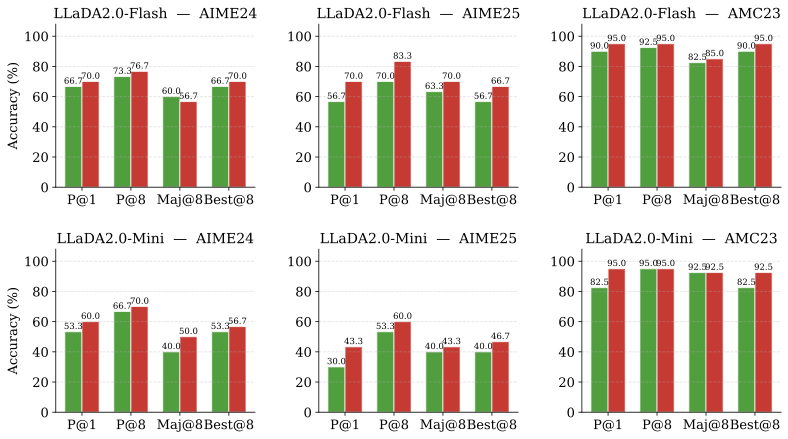
AIME 2025 pass@1 with LLaDA2.0-Flash
AMC 2023 pass@1 with both Flash and Mini
AIME 2025 pass@8 candidate upper bound
@article{sun2026escaping,
  title={Escaping Confidence Trap: Evolutionary Decoding for Mathematical Reasoning in Diffusion LLMs},
  author={Sun, Zhenhong and Zhao, Hanqing and Bian, Yatao and Tu, Rong-Cheng and Xie, Liuyue and Zhang, Xu and Wang, Jue and Modolo, Davide and Dong, Daoyi and Tao, Dacheng},
  journal={arXiv preprint},
  year={2026}
}