Abstract
Although text-to-motion generation has achieved strong progress in synthesizing realistic
single-person motions from language, extending it to text-driven 3D human–human interaction
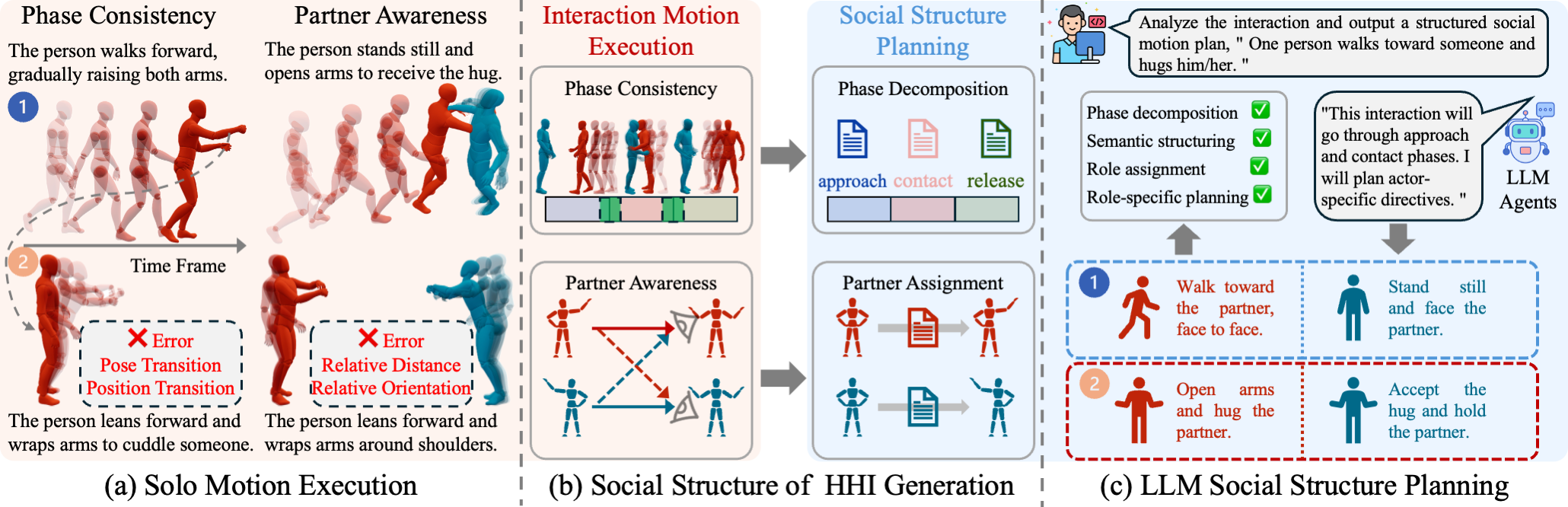
(HHI) remains non-trivial, as HHI requires modeling the underlying social structure
that governs phase progression, actor roles, and inter-actor coordination. In this paper, we
formulate HHI generation as a social structure modeling and grounding problem: the model must
first infer how an interaction unfolds and how the two actors coordinate their roles, and then
realize this structure as continuous, physically plausible, and partner-aware 3D motion. To
study how such structure should be modeled, we first examine the capability boundary of large
language models (LLMs) for HHI generation. Our analysis shows that LLMs can think by
recovering phase decompositions and partner-aware roles, but cannot directly move, as
they fail to generate dynamic, physically plausible, and interaction-aware motion. This
motivates our planner–executor paradigm, Think with LLM, Move with Motion Skill.
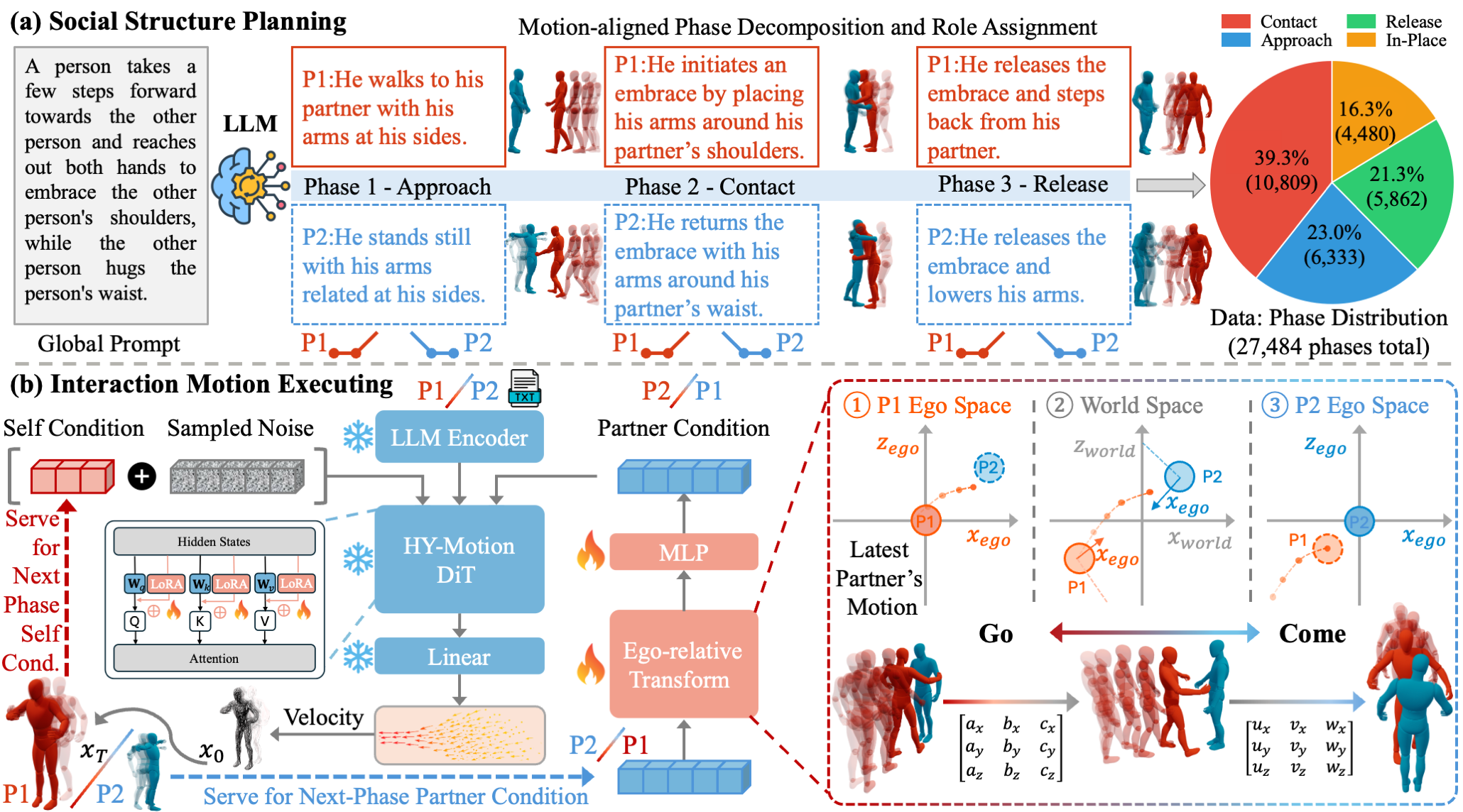
The LLM planner converts implicit interaction semantics into motion-aligned social supervision
by decomposing interactions into phases, assigning partner-aware actor roles, and aligning them
with motion sequence. The motion executor then grounds the planned social structure into
coordinated two-person motion by adapting a pretrained solo motion model with LoRA,
previous-phase self-conditioning, and ego-relative partner conditioning. Together, our
Solo-to-Social framework bridges social organization and motion realization,
producing 3D HHI with improved phase consistency, role alignment, and partner-aware coordination.