Meso-scale voxelization
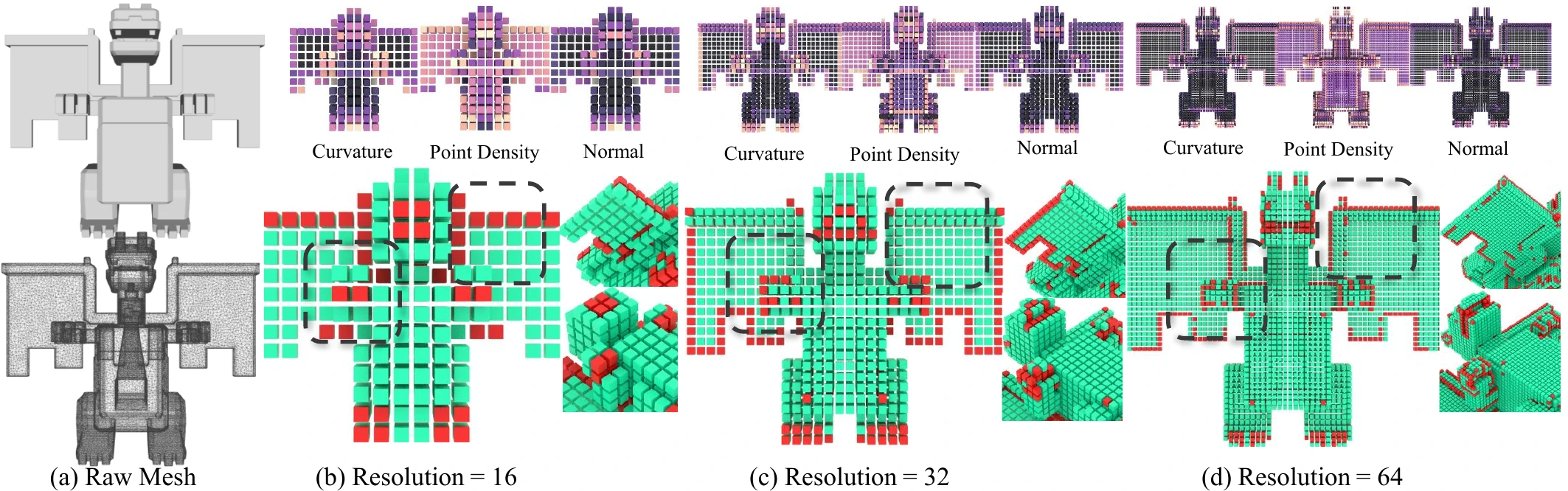
Curvature, normal variation, and point density reveal complementary structural evidence at several resolutions.
Geometry-only 3D part decomposition

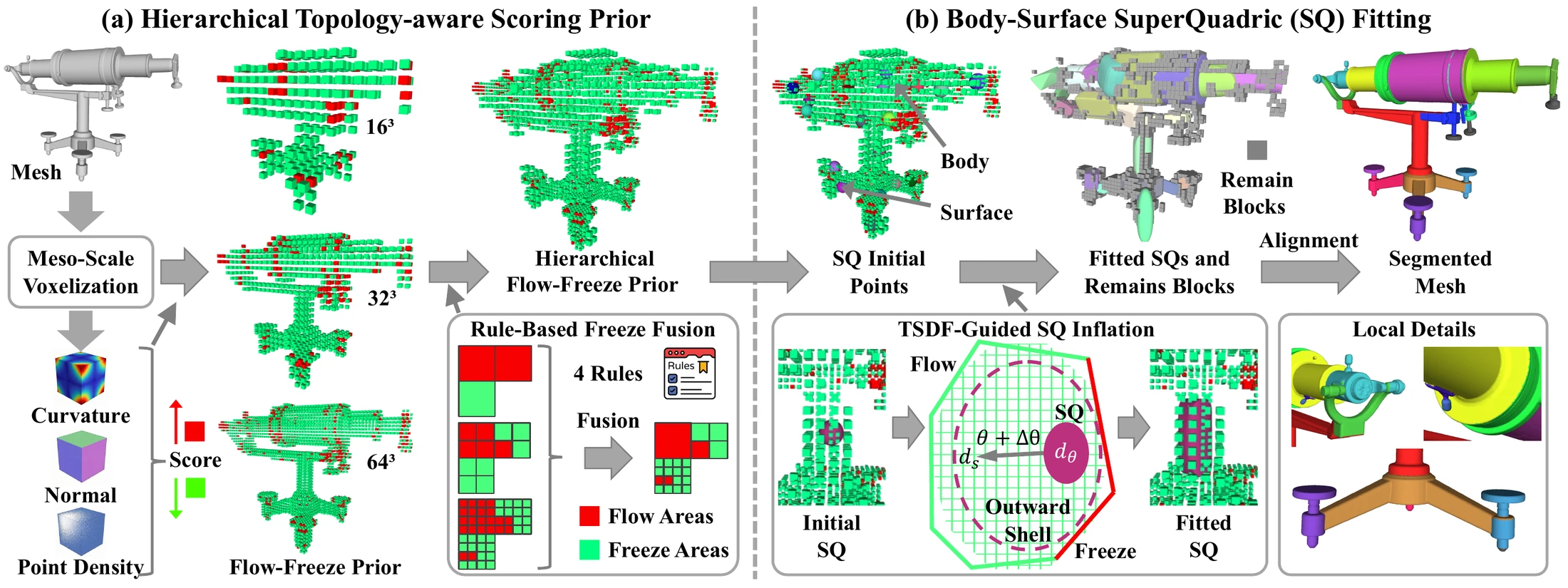
Hi-TOPS turns intrinsic mesh geometry into a hierarchical Flow-Freeze prior, guiding superquadric fitting toward coherent volumetric parts while preserving articulation seams and thin structures.
Overview
Why Hi-TOPS
Accurate 3D part decomposition requires separating shapes into structurally meaningful components with precise boundaries while preserving articulation seams and thin attachments. Existing approaches often suffer from a structural-scale mismatch: geometric evidence for separation is most reliable at the meso scale, yet many pipelines operate either too globally to respect joints or too locally to remain robust to noise. We propose Hi-TOPS, a Hierarchical Topology-aware Scoring Prior that aggregates complementary intrinsic cues into a multi-resolution Flow-Freeze field. Flow regions provide expandable support for primitive coverage, while Freeze regions restrict growth near articulations and thin structures. A TSDF-guided body-surface superquadric fitter then captures dominant cores and residual surface structures, followed by SQ-to-mesh assignment for connected, boundary-aligned parts. Across diverse benchmarks, Hi-TOPS delivers stable, editable decompositions without semantic supervision or 2D foundation priors.
Method
Three stages bridge stable meso-scale evidence and surface-aligned mesh parts.
Curvature, normal variation, and point density reveal complementary structural evidence at several resolutions.
Rule-based fusion preserves stable body support while refining boundary-sensitive regions at finer scales.
TSDF guidance expands superquadrics through Flow regions and stops them near Freeze boundaries before surface assignment.
Results
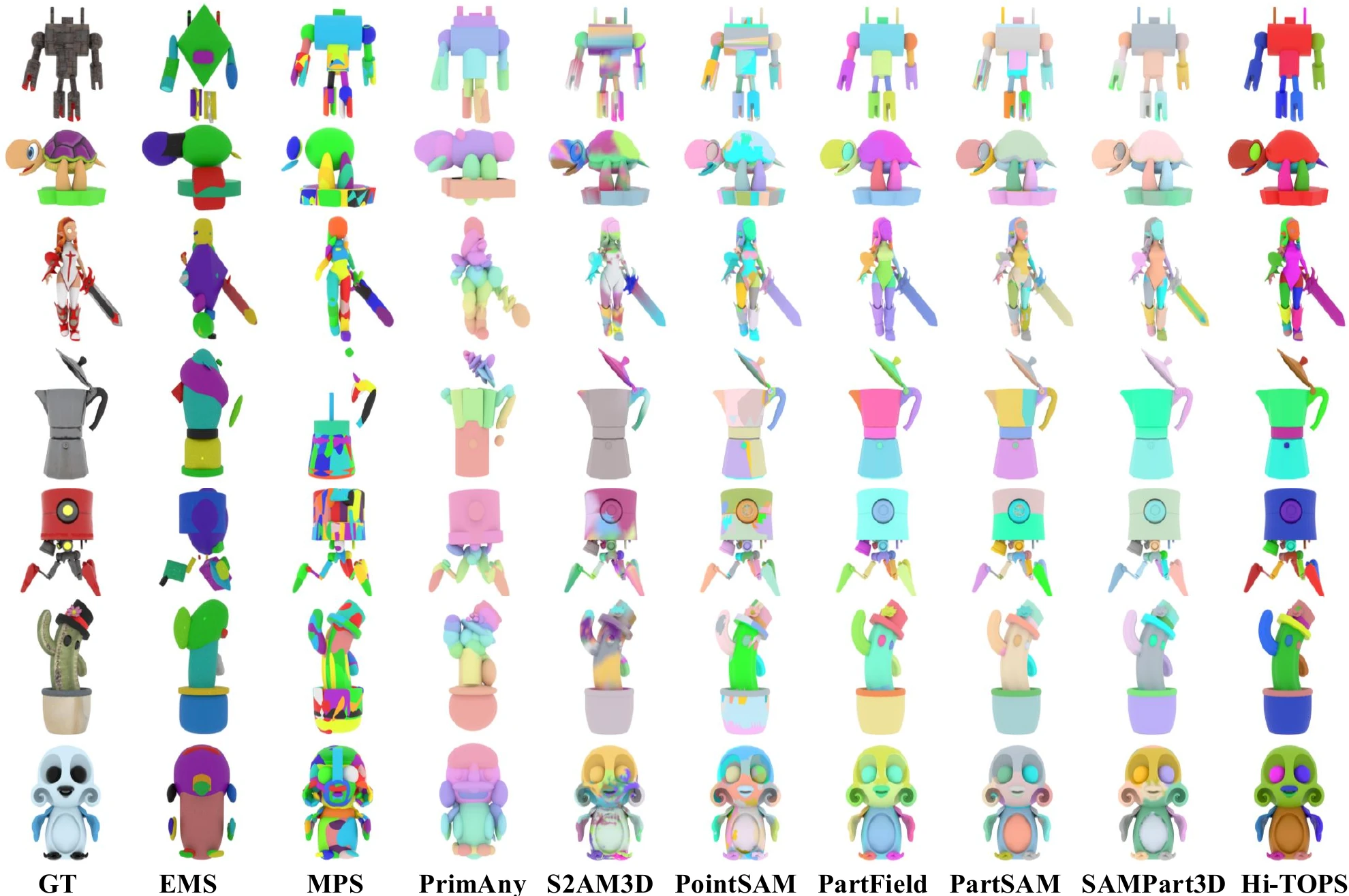
Hi-TOPS remains competitive with learned systems while requiring no training data.
Main comparison
Reported on three public part-annotated benchmarks. Higher is better.
| Method | Training | PartObj. | PartNet | HY3D-B. |
|---|---|---|---|---|
| EMS | No | 14.24 | 11.21 | 16.96 |
| MPS | No | 23.72 | 23.89 | 25.25 |
| PrimAny | Yes | 26.54 | 22.81 | 26.40 |
| S²AM3D | Yes | 30.64 | 29.77 | 22.20 |
| SAMPart3D | Yes | 46.74 | 29.48 | 43.90 |
| PartSAM | Yes | 49.15 | 30.16 | 55.13 |
| PartField | Yes | 66.77 | 45.57 | 44.56 |
| PointSAM | Yes | 43.27 | 27.66 | 32.94 |
| Hi-TOPS | No | 51.63 | 55.87 | 47.22 |
Structural fidelity
Hi-TOPS delivers the strongest PartNet VoI and SC while maintaining stable performance across datasets.
| Method | PartObjaverse-Tiny | PartNet | ||||
|---|---|---|---|---|---|---|
| RI ↑ | VoI ↓ | SC ↑ | RI ↑ | VoI ↓ | SC ↑ | |
| MPS | 0.719 | 2.370 | 0.295 | 0.734 | 2.216 | 0.338 |
| EMS | 0.373 | 1.770 | 0.283 | 0.372 | 1.897 | 0.277 |
| PrimAny | 0.744 | 2.453 | 0.292 | 0.746 | 2.561 | 0.273 |
| SAMPart3D | 0.818 | 1.300 | 0.541 | 0.574 | 1.949 | 0.333 |
| PartSAM | 0.772 | 1.563 | 0.481 | 0.791 | 1.814 | 0.427 |
| PartField | 0.815 | 1.088 | 0.548 | 0.837 | 1.625 | 0.493 |
| Hi-TOPS | 0.778 | 1.237 | 0.544 | 0.796 | 1.444 | 0.532 |
Values are transcribed from the Hi-TOPS arXiv preprint.
Reference
Please cite the Hi-TOPS arXiv preprint.
@article{wu2026hitops,
  title   = {Hi-TOPS: Hierarchical Topology-aware Scoring Prior for 3D Part Decomposition},
  author  = {Wu, Ruoyu and Sun, Zhenhong and Gong, Xiaoming and Xian, Yuxin and Wang, Zhi and Chen, Yawen and Mo, Huadong and Dong, Daoyi},
  journal = {arXiv preprint arXiv:2608.00767},
  year    = {2026},
  url     = {https://arxiv.org/abs/2608.00767}
}